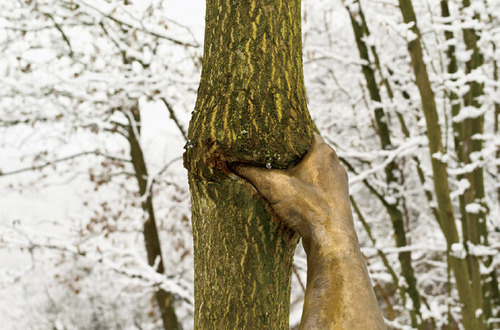
Found a lot of interesting and inspiring examples of Tree art and the human form as I've been researching and thought I should include some examples as a type of mood blog for the project. Been looking into so many different ways trees are used visually in sculpture, photography, ritual and as art pieces. It's helping me decide and push the project in the type of directions concerning the human form and the aura trees have.
It's gave me a better understanding of how trees influence us and how we engage with them and also how important they can be. Trees
seem to create such a strong presence and have different auras surrounding
them and a lot going on for them to thrive and survive. Their constantly
growing and competing for sunlight and rain so they can produce food and
nutrients as well as buds. These then can start new life cycles and germinate
the female and male buds to create new trees and ensure new growths of the same
type of trees. They provide shelter from the sun and home to many animals and
insects as well producing endless resources for humans. Especially
as tools in the art world since we use paper as usually a starting point
and resin and latex also come in forms from trees as well. Feel positive using the trees and natural materials as a theme and very inspiring about and our relationship with them creatively.
Giuseppe
Penone(born April 3, 1947) is anItalianartist. Penone started working professionally in 1968 in the
Garessio forest, near where he was born. He is the younger member of the
Italian movement named "Arte
Povera", this term has been coined byGermano
Celant. Penone's work is concerned with
establishing a contact between man and nature. He still actively produces new
work.
His sculptures, installations and drawings have
always been distinguished by his radical choice of unconventional materials and
use of processes that are an integral part of his work. Each work reaches
completion through the assimilation of its actions to those of the natural
elements and grows out of reflection that adhere closely to the concrete,
visual, tactile and olfactory qualities of the materials, explored by the
artistic ways that bring out their magical and fantastic groundwork.
Examples of his Work:
Proiezione, 2000
Tree of 12 Metres
1980-2
The tree, a living organism, in appearance so
closely resembling the human figure, is a central element in Penone's work.
Many of the procedures he adopts in the creation of his works are based on the
act of relating different entities and forces, hence on traces or memories of
the contacts between them.
In Penone's work, above all its more recent
developments, the opposed concepts of identità ("identity") and identicità ("analogy")
are assimilated according to a logic that is not extraneous to the Italian
language, as in other European languages in which the two cognate words share
the same etymon. The assimilation is shown in the process by which the artist
emphasizes similar behaviors that belong to different entities by fossilizing
them in a form. As a result, images are created that are capable of making the
thoughts and imagination of those who observe them flow from one material to
another, from one subject to another, from an animal body to a vegetable or
mineral body.
'Spazio di Luce' (Space of Light) at the Whitechapel Gallery 2012-13
'The Hidden Life Within'
In December 1968 he performed a series of acts in a
wood near his home, the region of the Maritime Alps. In this work, titled Alpi Marittime, Penone intervened in the growth processes of a
tree, whose form retained the memory of his gesture over time. One of his acts
involved the flow of the waters in a stream, the vital sap which gives strength
to the tree and on which the artist draws constantly in his work, a vehicle of
growth and proliferation. He interlaced the stems of three saplings in Ho intrecciato tre alberi ("I
Have Interwoven Three Trees") and uses nails to leave the imprint of his
hand on the trunk of a tree and then affixed twenty-two pieces of lead to it,
the number of his years, joining them up with zinc and copper wire: Albero/filo di zinco/rame ("Tree/Wire
of Zinc/Copper). He enclosed the top of a tree in a net burdened by the weight
of plants: Crescendo innalzerà la
rete ("Growing It Will Raise The Net). He pressed his body to
a tree and marked on the trunk the points of contact with barbed wire: L'albero ricorderà il contatto ("The
Tree Will Remember the Contact").
Gli anni dell'albero più
uno ("The
Years of the Tree Plus One"); a bough covered with wax with, imprinted on
it, the bark of the tree on one side and on the other the gestures of the
artist; Alberi e pietre,
I rami dell'albero più uno, Zona
d'ombra ("Trees and Stones, The Boughs of the Tree Plus One,
Shadow Zone") were all created between 1969 and 1971 in the forest of
Garessio, where the artist assimilated his work to the behavior of other living
things, for the most part, trees.
Penone has made bronze trees which have been
erected in various public spaces. One example is the Pozzo di Münster ("Well of
Münster") created for the 1987 edition Skulpture Projects; on its trunk
was the imprint of a hand which gushed water. Others were the Faggio di Otterloo ("Beech
of Otterloo") conceived for the outdoor sculptures park, the Rijksmuseum
Kroller-Müller in 1988, the Albero
delle vocali ("Vowel Tree"), a sculpture thirty meters
long placed horizontally in the Tuileries in Paris, where
it has been installed since 2000, or Elevazione ("Elevation") 01 2000-2001, a large
tree raised off the ground in Rotterdam.
Penone in Arte Povera
Since 1969 Giuseppe Penone has been one of the
leading representatives of Arte Povera, the critical theory elaborated by Germano
Celant starting from 1967 and based on the work of a number of
Italian artists, principally Giovanni Anselmo, Alighiero
Boetti, Luciano Fabro, Jannis
Kounellis, Mario Merz, Giulio Paolini, Pino Pascali, Michelangelo
Pistoletto and Gilberto Zorio. These artists have numerous points in common,
above all the rejection of traditional artistic languages, the empirical and
non-speculative character of their works, and the value they place on the
anthropological dimension. The appearance of Penone in this group of artists
coincided with the emergence in the critical elaborations of the "magical
and wonder-arousing value of the natural elements".This was at a time when dialogue
and debate with the coeval international avantgardes was becoming most intense,
conducted through a series of group surveys in which Penone took part. These events
included Konzeption-Conception at
the Schloss Morsbroich in Leverkusen in 1969, conceptual art arte povera land art at the Galleria Civica
d'Arte Moderna in Turin andInformation at
the Museum of Modern Art, New York, in 1970.
Penone's work mainly consists of using the actual form of tree's as his subject matter and his sculptures. He finds creative and skilled ways to use the whole of the tree to make symbolic statements will keeping them to their true forms. He uses the message of memory to make statements about his interactions with the natural forms and uses this theme to complete his sculptures. He usually makes imprints of his body/finger prints/hands and even his breath to leave his marks that he has been part of the process of each piece. I feel his work is very important in tradition of the human conscious of making marks in something as ancient as a tree. That making messages in trees shows the relationship humans have we the earth and how we leave our marks in rural environments. How we form relationships and leave our 'imprints' on people and places and how it can form and show our growth like trees.
Born in 1972 in Vipiteno, Demetz lives and works in Selva di Val Gardena
1986-93 Instituti d’arte di Selva Val Gardena
1997-98 Academy of Fine Arts Nuremberg, under Professor Christian Höpfner
Italian sculptorAron Demetz(cousin of Gehard Demetz, whose work we featured in Hi-Fructose Vol. 22) creates wood sculptures that appear distressed, burnt and scarred. The process of working with wood is a fundamental part of Demetz’s aesthetic — instead of presenting polished and perfected works, Demetz celebrates the wood’s textures and its transformation through various natural processes. The simplified, abstracted human figures can seem like personifications of the wood itself.
Aron
Demetz uses traditional woodcarving techniques to convey his preoccupation with
humanity’s relationship to nature. In his work he eschews the classical
opposition of human and nature, and allows the two to become an inseparable
whole, evoking the primordial experience.
Born in
Val Gardena, in northern Italy, where he continues to live and work, Demetz
adopted a traditional South Tyrolean technique of woodcarving that dates back
to the 17th century. His sculptures – depicting the human figure in classical
postures or unusual awkward positions – explore the possibilities and
limitations of wood as a material. The resulting works have a strong physical
presence, which deeply engage the viewer on a psychological level, conveying
both our oneness with nature and our alienation from it.
In the
piece ‘Untitled’, conceived for the Italian Pavilion at the 53rd Venice
Biennale, Demetz introduced the use of natural resin, meticulously collected
from wounds on the trees in the Val Gardena forests. With its smell, colour,
and texture, it gives his signature wood sculptures even more corporeal
presence and adds a lyrical dimension to his powerful work.
Examples of his work:
The charred remains of the artist's works evoke a new range of sentiments that delve deeper into the vulnerabilities of both the wooden materials they are composed of and the human figures they represent. Demetz's sculptures present mankind and nature as one, reflecting the fragility of both. The burned structures peel back the facade of the figurative forms and expose their susceptibility to hindering elements, both in the literal and metaphoric sense. The wood-turned-charcoal figures present an interpretive look at the outcome of physical and emotional onslaught.
Expanding on his interest in the human
figure, Demetz works with wood to evince conflicting notions of temporality and
the quest for permanence. By reviving the religious tradition of wood carving
that has flourished in the Northern Italian town of Val Gardena since the 17th
century, Demetz brings a rich spirituality to his sculptures. Yet he
simultaneously imbues his work with an oddly fitting contemporary touch by layering
silver or aluminium foils or pouring resin over his figures. The resulting
effect is startlingly truthful in capturing the complexity of the ties that
bind us to the natural world.
Demetz work has really interested me in the human form and it's relationship with nature his sculptures are beautiful but also have a powerful visual. That
looking at them we can relate and see our own form that were comfortable with
but as a still material that is expressing strong visual emotion. His works
relationship between man and nature felt valuable in my research as it’s a relationship
I’ll be exploring in this project. His use of different methods of manipulating the wood to express different moods appealed to my experimentation of natural materials I would like to achieve.